Copper billet casting
For round billet projects feeding extrusion, forging, tube, or specialty alloy production.
Copper Billet Casting Route
Review when semi-continuous casting is the right route for copper billet, copper alloy billet, rectangular slab, and hollow billet production.
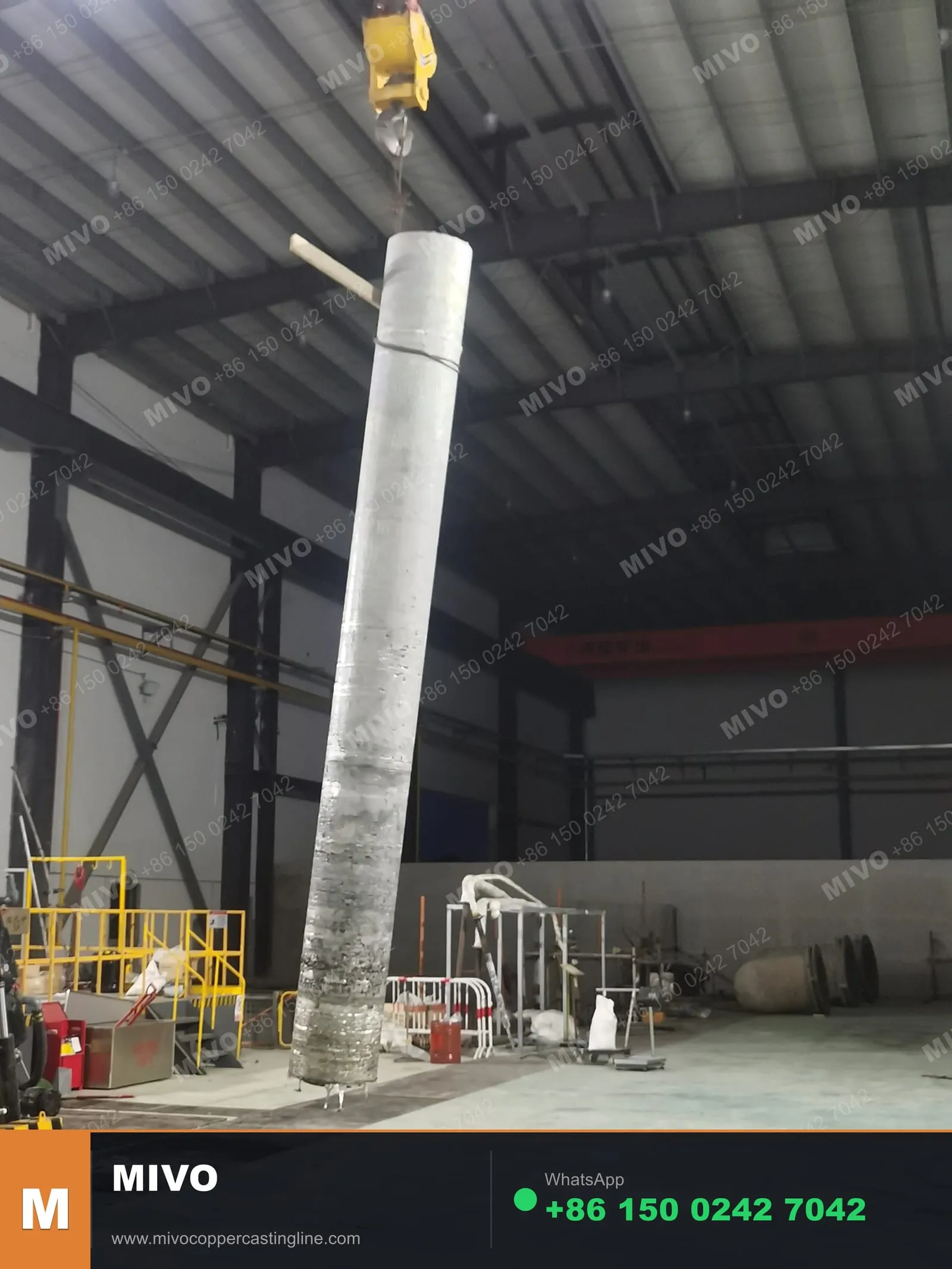
Semi-continuous (direct-chill) casting is a vertical casting process for producing large-format copper and copper alloy billets, slabs, and hollow billets. Unlike upward continuous casting, the semi-continuous process produces a fixed-length billet in each cast cycle, which is then cut to length and transferred to downstream processing (extrusion, forging, rolling).
The process uses water-cooled copper or aluminum molds. As the billet exits the mold, it is immediately quenched with direct water spray — the "direct-chill" step — which rapidly solidifies the surface and outer zone. This produces a fine-grain structure and tight dimensional tolerances across large cross-sections.
Semi-continuous casting is particularly well-suited for copper alloys including brass, bronze, copper-nickel, and precipitation-hardening alloys such as CuCrZr, where precise composition control and homogeneous microstructure are critical.
For round billet projects feeding extrusion, forging, tube, or specialty alloy production.
For rectangular slab projects feeding rolling, plate, strip, or downstream copper processing.
For tube extrusion projects where hollow billet size and handling method define the line scope.
Semi-continuous casting should be reviewed when the target product is a copper or copper-alloy billet, slab, or hollow billet that will move into downstream extrusion, forging, rolling, tube production, or specialty copper-alloy processing. The equipment route is usually judged by alloy grade, billet dimensions, slab dimensions, cast length, production target, and the downstream process that will use the cast material.
For these projects, Mivo reviews the alloy or copper requirement, mold dimensions, furnace capacity, cooling method, withdrawal arrangement, handling method, and plant utilities before proposing a configuration. The purpose is to match the casting route to the product route instead of applying one standard machine layout to every inquiry.
If the buyer's target is oxygen-free copper busbar, strip, or flat copper profiles, the project should also be compared with an upward continuous casting route, because that line is designed around continuous flat-profile production rather than fixed-length billet or slab casting.
A semi-continuous copper billet casting machine is usually considered when the buyer needs cast stock for extrusion, forging, rolling, tube production, or copper-alloy processing. The first review should confirm whether the target output is round billet, rectangular slab, or hollow billet, because each product form changes the mold, withdrawal, cooling, handling, and downstream process discussion.
For Africa, Middle East, and Southeast Asia projects, the inquiry often needs more than a basic equipment price. Mivo usually reviews alloy grade, billet or slab dimensions, cast length, output target, power supply, cooling-water condition, workshop layout, and lifting or handling arrangement before discussing equipment scope, export delivery, commissioning support, operator training, and common spare-parts planning.
Use this page to decide whether semi-continuous casting is the right production route. Use the machine page when you are ready to discuss manufacturer scope, equipment configuration, export packing, factory acceptance review, and commissioning support.
Send your product form, alloy, dimensions, annual output, downstream process, and plant conditions. Mivo will review the right semi-continuous casting scope.
Get ROI & PricingSemi-Continuous Casting FAQ
These answers support buyer search intent around copper billet casting machines, quotation inputs, export support, and process selection.
It is used to produce fixed-length copper and copper alloy billets, slabs, and hollow billets for downstream extrusion, forging, and rolling projects.
Buyers should send the product form, alloy grade, billet or slab dimensions, cast length, annual output target, downstream process, and plant conditions such as power, cooling water, layout, and handling arrangement.
Yes. Mivo supports export projects with equipment scope review, shipment preparation, factory acceptance planning, commissioning coordination, operator training, and follow-up support according to project scope.
No. Semi-continuous casting is usually reviewed for billet, slab, or hollow billet output. Upward continuous casting is usually reviewed for oxygen-free copper busbar, strip, or flat copper profile output.
This page is for buyers comparing a semi-continuous casting route for copper billet, copper alloy billet, rectangular slab, or hollow billet projects before requesting a manufacturer quotation.
Get in touch
Our engineers can help you select the right equipment configuration for your capacity needs and product specifications.